
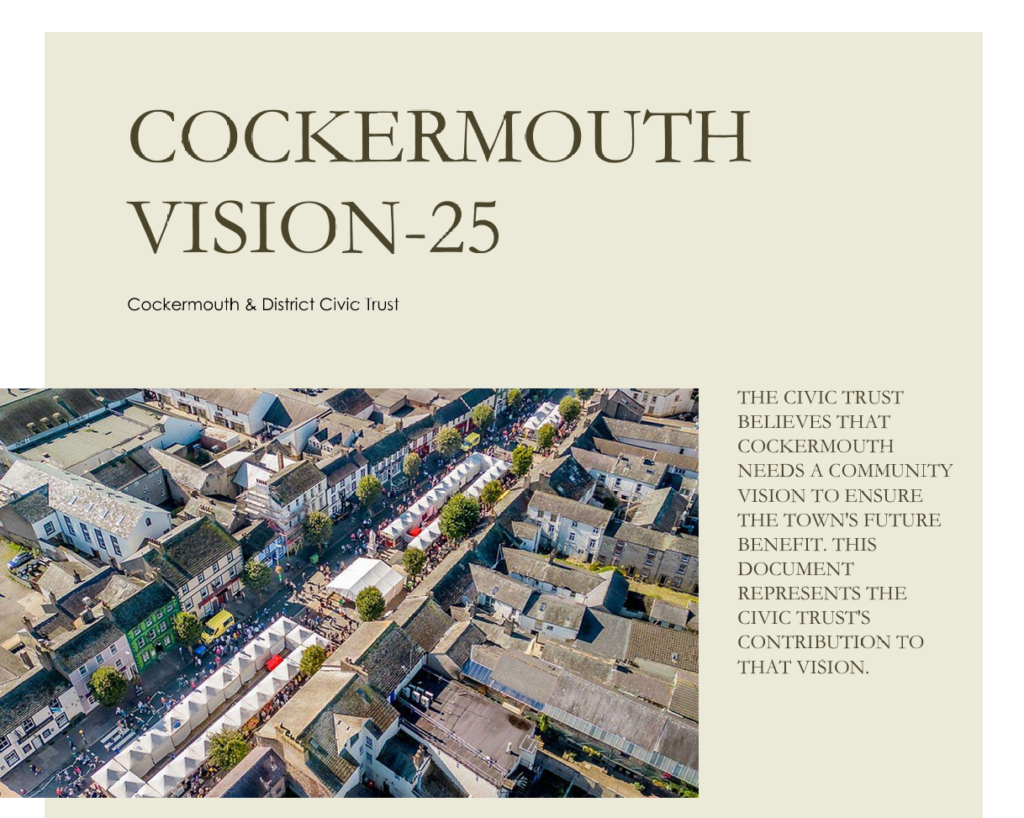
Cockermouth Vision-25
Published by Cockermouth & District Civic Trust — January 2025
Download the document here.
Introduction
Cockermouth and District Civic Trust is a voluntary organisation and charity with nearly 60 years of history. The Trust aims to preserve and stimulate public interest in Cockermouth and its surroundings, promote high standards of town planning and architecture, and secure the preservation and improvement of features of public or historic interest.
While maintaining the town’s character and identity, the Trust supports evolution to meet 21st-century needs. It advocates for proactive community involvement in shaping the town’s future, identifying positive development opportunities ready to be advanced when funding becomes available.
This document presents the Civic Trust’s Vision-25, which aims to evolve into a comprehensive community vision with contributions from local people and organisations.
Historical Background
Cockermouth has a long and important history. At Papcastle, it was the site of the Roman frontier fort and town of Derventio. It became the Norman settlement of ‘Cokyrmoth’ in the 12th century, and much of the structure of the town centre dates from this time.
Buildings in the town date from the late medieval period onwards, with a predominance of Georgian frontages in the town centre. There are over 200 Grade II listed buildings, along with Cockermouth Castle and Wordsworth House — both Grade I listed. The historic centre was declared a Conservation Area in the late 1960s and much of its character has been retained.
Cockermouth has long been a market town, receiving its first royal market charter in 1221. It is the birthplace of William and Dorothy Wordsworth, scientist John Dalton, and royal astronomer Fearon Fallows, and was the first town in the country to introduce gas — and later electric — street lighting.
In recent times the pace of change has increased, with deindustrialisation, advances in technology, the rise of online shopping, and significant population growth all placing new pressures on the town. Cockermouth needs to continue to adapt and move forward.
Our Ambition
Cockermouth should be an attractive, enjoyable and distinctive town where residents are proud to live and shop. It needs to respect its heritage whilst adapting to the needs of the 21st century and becoming resilient to external factors such as climate change.
To achieve this, the town needs to provide local employment, attract customers from the wider local area, and welcome visitors from beyond. New developments in the town centre should respect the existing architectural structure and heritage. Both Cumberland Council and the Town Council should be unrestrained in their ambitions for the town, and building owners, tenants and the community at large must play their part in achieving the high standards necessary.
The town should actively pursue recognition as a ‘green town’, with environmental sustainability addressed in all new developments over and above minimum legal requirements.
Key Assets
Cockermouth has many strengths to build on:
- The Conservation Area — a legally designated area of special architectural and historic interest
- The character of Main Street, Station Street and Market Place, along with traditional shop frontages
- The town’s tree-lined streets, which have become a defining part of its identity
- A strong number of independent shops and their business viability
- Harris Park and the Memorial Gardens
- Good road connections to the Lake District National Park, the Solway Firth and West Cumbria
- Wordsworth House and the Wordsworth family connection
- A rich heritage of poets and artists — including the visiting J.M.W. Turner, who painted Cockermouth Castle, and current resident Julian Heaton Cooper
- Cockermouth Castle, the oldest building in the town, largely dating from the 14th century
- Kirkgate Arts and Heritage Centre
- Smaller buildings of public and tourist interest, including Banks Ironmongers, Percy House and Castlegate Gallery
- Green spaces, parks and inspiring views toward the Lake District Fells
- Nearby tourist destinations such as Setmurthy and Whinlatter Forest Park, which could be better connected to the town
- All Saints Church — an important landmark with potential for greater public benefit
Issues Facing the Town
Alongside its strengths, Cockermouth faces a number of challenges that need to be addressed:
- The town centre lies on the flood plain of the Cocker and Derwent rivers
- Cockermouth has become a dormitory town with relatively few local employment opportunities
- The historic town centre structure creates congestion at certain times of day, and must remain pedestrian-friendly
- Some recent developments — such as the Lowther Went shopping area — have not respected the local built environment
- The unique character of the town is being eroded by inadequate enforcement of the shopfront design guide
- Buildings on the south side of Crown Street present a poor image at a main entry point to the town
- Pavements on Station Street and the south side of Main Street are in poor condition
- The town turns its back on the rivers and fails to take full advantage of them
- The partially collapsed Old Courthouse is both an eyesore and a growing weakness in the town’s flood defences
- The closure of Jennings Brewery has left a significant riverside site in need of redevelopment
- Uncertainty over the Mitchells building and old fire station on Lorton Street presents both a challenge and an opportunity
- There is a perceived lack of facilities and entertainment for young people
- The town has lost tourist attractions it once had, including a printing museum and a toy museum
- Public footpaths in and around the town are currently disconnected
Nine Proposed Projects
The Civic Trust has identified nine development schemes to help realise this vision. Each will require investment and partnership working to deliver.
1. Lowther Went Redevelopment The large Lowther Went site — including the former Wilco building — offers a prime opportunity for redevelopment into a pedestrian-friendly street connecting Main Street and South Street, with new mixed-use buildings providing retail, offices and residential space.
2. Brewery Site and River Confluence The former Jennings Brewery site offers opportunities for housing, mixed-use development, education facilities, or a combination. There is also potential for a smart energy demonstration facility using water power from the River Cocker. A new footbridge to the Memorial Gardens would support circular walking routes through the town.
3. New Town Centre Housing — Lorton Street The Lorton Street and Station Street junction — encompassing the Mitchells site, the old fire station, and the Grand Theatre building — could be developed into a cohesive residential neighbourhood with a mix of townhouses, terraces, apartments and flats.
4. Slatefell Streetscape Enhancement Redesigning street junctions with planting and tree-lined avenues would create a more pedestrian-friendly environment and improve the appearance of the Slatefell estate. Planted build-outs can also act as surface water drainage, easing pressure on the town’s rivers.
5. Fairfield Car Park Expansion Increasing capacity at Cockermouth’s most popular and best-located car park — using low-profile modular solutions — would improve parking provision, free up other car parks for development, and help control costs.
6. Gote Bridge Flood Improvement Replacing the three flat arches of Gote Bridge with a single span would reduce the damming effect on the river and could lower flood water levels upstream by up to one metre during heavy rainfall events.
7. Upstream Flood Mitigation Investing in natural flood management measures upstream — including tree planting, leaky dams, and the use of natural flood plains — could significantly improve the town’s flood resilience at lower cost than in-town defences alone. A flood levy on new town-centre developments should also be explored.
8. Public Footpath Connectivity Connecting and extending the network of public footpaths in and around the town would encourage residents and visitors to explore on foot. Proposed new routes include a riverside path from Papcastle via Sandair, a route along the River Derwent from Low Road to the Fitz roundabout, and exploration of paths on both sides of the Derwent north of the castle.
9. The Old Courthouse The partially collapsed Old Courthouse requires urgent attention. As a minimum, the collapsed rear section must be demolished and the flood defences reinstated. A wider decision is then needed on whether the Grade II listed frontage can be saved and repurposed, or whether the whole site should be cleared to make way for a public park, museum, or new commercial or residential development.
Get Involved
Vision-25 is the Civic Trust’s contribution to a wider community conversation. We want to hear from residents, businesses and local organisations — your ideas and priorities will help shape the future of Cockermouth.
Vision-25 is published by Cockermouth and District Civic Trust, 2025.